
Offering Dropbox and Google Drive storage options
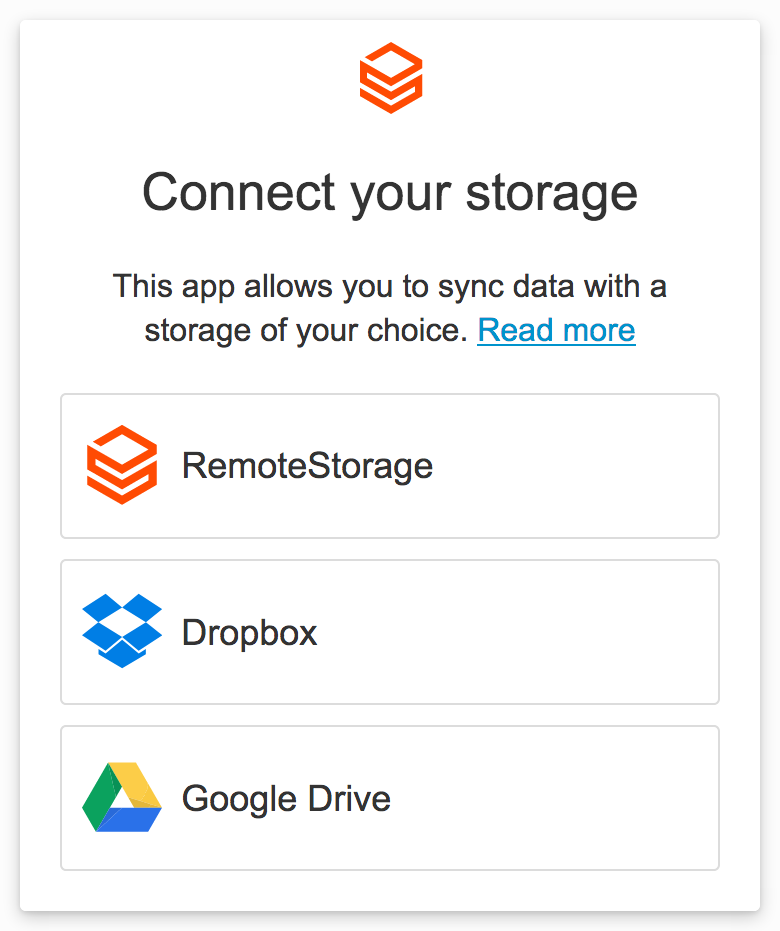
rs.js has optional support for syncing data with Dropbox and Google Drive instead of a RemoteStorage server.
There are a few drawbacks, mostly sync performance and the lack of a permission model. So apps can usually access all of a user's storage with these backends (vs. only relevant parts of the storage with RS accounts). However, while RS is not a widely known and deployed protocol, we find it helpful to let users choose something they already know, and potentially migrate to an RS account later on.
For these additional backends to work, you will have to register your app with Dropbox and/or Google first. Then you can configure your OAuth app ID/key like so:
remoteStorage.setApiKeys({
  dropbox: 'your-app-key',
  googledrive: 'your-client-id'
});
INFO
The Connect widget will automatically show only the available storage options, based on the presence of the Dropbox and Google Drive API keys. RemoteStorage is always enabled.
Dropbox
An app key can be obtained by registering your app.
Create a new "scoped" app for the "Dropbox API", with these scopes:
account_info.readfiles.metadata.readfiles.metadata.writefiles.content.readfiles.content.writesharing.readsharing.write
WARNING
The sharing.read and sharing.write scopes are required for generating shared links via getItemURL() (see Sharing public files via Dropbox).
If you are upgrading an existing integration, you must enable these two scopes on the "Permissions" tab of your app in the Dropbox App Console, otherwise Dropbox will reject new authorization requests with an invalid_scope error. Existing users will need to re-authorize your app after you enable the scopes.
You need to set one or more OAuth2 redirect URIs for all routes a user can connect from, for example http://localhost:8000 for an app you are developing locally. If the path is '/', rs.js drops it.
Known issues
- Storing files larger than 150MB is not yet supported
- Listing and deleting folders with more than 10000 files will cause problems
- Content-Type is not fully supported due to limitations of the Dropbox API
- Dropbox preserves cases but is not case-sensitive
Google Drive
A client ID can be obtained by registering your app in the Google Developers Console.
- Create an API, then add credentials for Google Drive API. Specify you will be calling the API from a "Web browser (Javascript)" project. Select that you want to access "User data".
- On the next screen, fill out the Authorized JavaScript origins and Authorized redirect URIs for your app (for every route a user can connect from, same as with Dropbox)
- Once your app is running in production, you will want to get verified by Google to avoid a security warning when the user first connects their account
Known issues
- Sharing public files is not supported yet (see issue 1051)
getItemURL()is not implemented yet (see issue 1054)
Sharing public files via Dropbox
BaseClient.getItemURL() is supported for the Dropbox backend. It returns a Dropbox shared link URL for files stored under the /public/ folder, creating one via the Dropbox API on first request and caching it in localStorage for subsequent calls.
Getting the raw file URL
The shared link returned by Dropbox for a file is, by default, an HTML preview page (a "shared link" view in the Dropbox web UI), not the raw file content. This is fine for sharing a link with a human, but it does not work when you need to embed the file directly, for example inside an <img> tag, an <audio> element, or a fetch request for binary data.
To get the raw file URL, replace the ?dl=0 query parameter on the shared link with ?raw=1:
const url = await client.getItemURL('public/images/photo.jpg');

let rawUrl = url;
if (url && url.includes('dropbox.com')) {
  rawUrl = url.replace('dl=0', 'raw=1');
}

// Now safe to use in an <img> src, fetch(), etc.
element.style.backgroundImage = `url('${rawUrl}')`;
TIP
This dl=0 → raw=1 substitution is specific to Dropbox shared links and is not part of the rs.js API. It is a workaround for Dropbox's default behavior of serving a preview page. Apps targeting both remoteStorage and Dropbox backends should check the URL host before applying the substitution, as shown above.